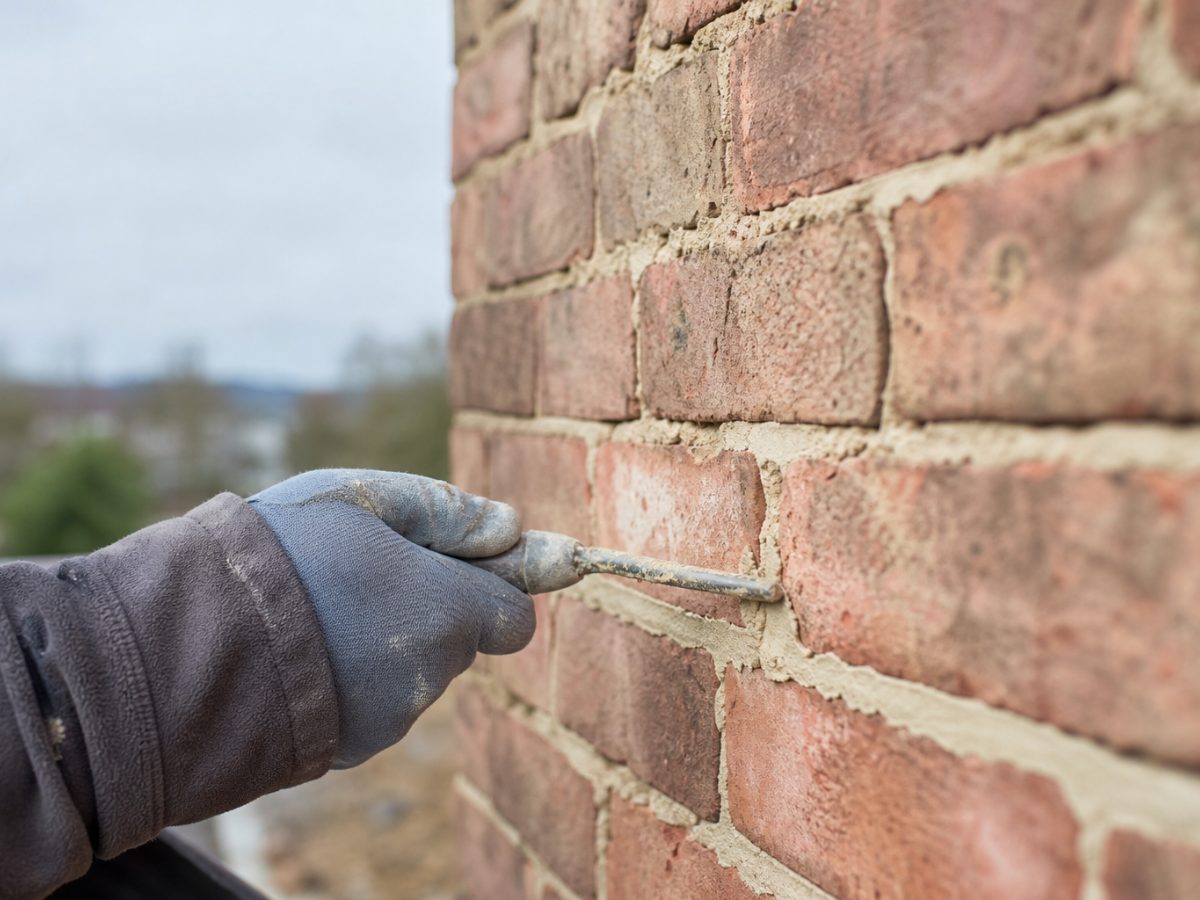
Most people assume repointing is simple maintenance work. You chip out the old stuff, trowel in some new mortar, job done. That assumption has caused serious, lasting damage to thousands of older Irish homes, and it's entirely avoidable once you understand what's actually going on in the wall.
Why mortar matters more than most people think
Brick and stone walls are not completely solid. They breathe. Moisture gets in through rain, through the ground, through condensation, and the wall needs to be able to release that moisture back out. In older buildings, the mortar between the stones or bricks was specifically designed to be the softer, more permeable element in the wall. It acted as a sacrificial layer. If something had to crack or deteriorate over time, better the mortar than the masonry itself. That is a feature, not a flaw.
The problem starts when you repoint with ordinary cement-based mortar. Cement is far harder and far less permeable than the original lime mortar used in most Irish properties built before the 1950s. When you pack a hard cement mortar into joints on a softer stone or brick wall, you block the wall's ability to shed moisture. That moisture has to go somewhere, so it migrates into the masonry itself. Over a few winters, you start to see spalling, where the face of the stone or brick literally breaks away. Damp patches appear on interior walls. Frost damage accelerates. What looked like maintenance work has actually set a slow deterioration in motion.
How to tell if your property needs lime mortar
The simplest rule of thumb: if your home was built before roughly 1950, assume it needs hydraulic lime rather than cement. That covers the vast majority of older Irish terraced houses, farmhouses, cottages and Victorian or Edwardian properties. The older the building, the more likely the original masonry is soft enough that cement mortar will cause real damage.
You can check the existing mortar yourself with a fairly simple test. Try to scratch the joint with a key or a nail. If the mortar is crumbly or sandy and comes away fairly easily, it is almost certainly a lime-based original mix. If it is rock hard and grey, someone has already repointed with cement at some stage. That is important to know because it means you may already have a moisture problem developing, and you need to think about removing the cement and replacing it properly, not just adding more on top.
Look also at the condition of the masonry itself. Flaking or pitting on the face of individual stones or bricks, especially near ground level or below windowsills, is often a sign that trapped moisture is already doing damage. If you spot this during an autumn maintenance walkround, it is worth addressing before winter frost makes it worse.
Choosing the right hydraulic lime mix
Hydraulic lime comes in different strengths, usually referred to as NHL 2, NHL 3.5 and NHL 5. The number relates to the compressive strength. Softer, more porous masonry needs a weaker mix, typically NHL 2 or NHL 3.5. Using NHL 5 on soft sandstone or handmade brick is still too hard for the purpose. If you are unsure, a conservation specialist or an experienced stonemason who works regularly on older Irish properties can advise you on the right specification for your particular wall.
The mixing ratios and curing conditions matter too. Hydraulic lime needs to be kept damp while it cures, which in a wet Irish climate is actually less of a problem than in drier countries. But it should not be applied in temperatures below about five degrees, which rules out a lot of the Irish winter entirely.
Getting the right person for the job
This is not work to hand to the cheapest labourer available. A surprising number of general builders still default to cement because it is what they know, it is fast and it is cheap. Before you hire anyone for repointing work, ask them directly what mix they intend to use and why. If they cannot answer that question clearly, vetting them properly before they start could save you a very expensive repair bill further down the line.
The original builders of most Irish stone and brick houses got the mortar right because they understood the materials. Matching that understanding is most of the job.